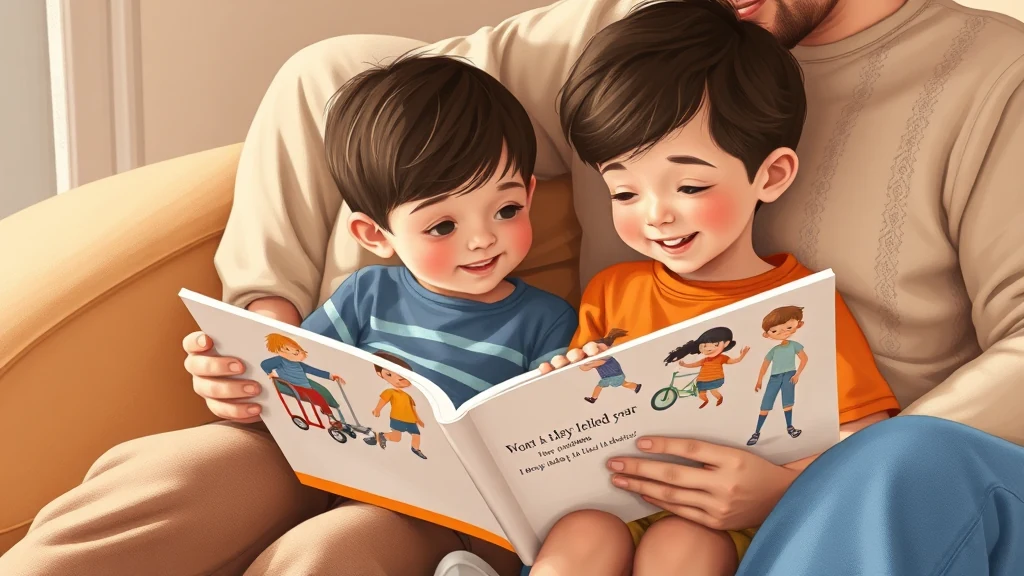
When Bodies Differ: Using Personalized Stories to Help Kids Understand Physical Disabilities
I remember being about seven years old. My friend Leo was in his wheelchair, and one day, I kept staring at it. It wasn’t out of mockery, or even lack of understanding, but pure, unfiltered curiosity. I asked my parents, “Why does it have wheels? Can it walk, too?”
The question wasn’t malicious; it was just… huge. It hit a nerve point for many parents: the moment when a child’s casual, innocent curiosity forces us to articulate complex, deeply emotional concepts-the nature of difference, the meaning of ability, and the reality of a physical disability-in language that must be both truthful and kind.
It is complex, isn’t it? We want to shield our children from sadness, but we also need to equip them with the language to understand the world as it truly is.
The biggest challenge in talking about physical disability to a young child isn’t the medical facts; it’s the emotion-the fear of the unfamiliar, the worry of being left behind, or simply the difficulty of understanding that ’normal’ is actually a very small and limited concept.
Shifting the Focus: From Deficit to Difference
Our cultural narratives, both in media and in old literature, often place a premium on physical ‘wholeness’ and visible perfection. When we teach our children about difference, we are, in effect, asking them to dismantle a powerful, often invisible, assumption: that there is only one way a body should look or work.
The best developmental advice I give is to constantly shift the conversation away from the deficit (what the person cannot do) and toward the capability (the things they still love doing, the unique ways they interact with the world).
Instead of saying, “Leo is unable to run like us,” the goal is to help your child hear: “Leo uses his chair to get places so he can still do all the fun things we love-like building huge block towers or baking cookies.” The focus shifts to the shared activity, the joint joy, and the resilience of the spirit.
This approach is foundational to building a disability-positive environment, helping children learn that difference isn’t a tragedy, but just another dimension of human identity.
A parent once told me that their daughter, Maya, was fascinated by her friend’s specialized braces. Instead of feeling awkward, Maya started drawing them, labeling them like parts of a futuristic superhero suit, and asking, “What does it help you do?” It was a perfect moment of reframing. By seeing the assistive devices not as medical necessities, but as tools-like a telescope or a fancy bike-the concept becomes functional and non-threatening.
When Stories Do the Heavy Lifting
This is where the magic of narrative comes in. Concepts like acceptance, empathy, and adaptability are deeply abstract. They are big, messy, emotional ideas that toddlers and young grade-schoolers struggle to grasp through pure conversation. They need the scaffolding of a story.
A personalized story offers a unique chance to anchor this learning in the child’s own world, using characters, settings, and even emotional beats that feel immediate and relevant to them.
The key is that the story itself must honor the reality of the disability while making the rest of the experience rich and fully capable. We are looking for narratives of strength, determination, and connection-stories where the unique ability (or unique method of doing something) is celebrated, not tolerated.
If you find that your child is constantly grappling with big, abstract emotional questions like this, sometimes the most effective way to make the lesson tangible and perfectly tailored to their life is to create a story that features their own name and world: https://makemybook.app/en/console.
Moving Beyond “Just Like Us”
I feel strongly that a common mistake parents make when tackling these topics is defaulting to stories that are either overly sanitized (ignoring the difficulty) or dramatically dramatic (creating undue pity). The middle ground is often where the real educational power lies.
I once worked on a personalized book centered on a character who uses a walking frame. Instead of spending pages detailing the effort of walking, the story focuses on the destination-the thrilling race to the playground, the triumphant moment of building the biggest sandcastle, or the deep laughter shared over a rainy afternoon. The physical limitation becomes a minor plot detail that the characters confidently navigate, never the defining feature of their personality.
This is critical because it teaches the child that the body is just one part of who they are. They are a builder, a dreamer, a friend, a comedian-all of those things, regardless of mobility.
How to talk about difference: A framework for parents
If you aren’t ready for a personalized story yet, here are a few conversational frameworks you can adopt:
- The “Tool” Metaphor: Treat adaptive equipment like specialized tools. “This wheelchair isn’t just for getting from point A to point B; it’s a super-fast, all-terrain vehicle that lets you reach all the best parts of the park.”
- The “Power/Ability” Statement: Focus on what the person brings to the table. “Even though running is hard for her, her superpower is making everyone laugh.”
- The “We All Differ” Reality Check: Normalize variation from childhood. “Your sister has curly hair, and I have straight hair. We are different, and both are wonderful.” This expands the concept of difference to include things as simple as hair color or height.
The Power of Representation
The goal isn’t to achieve “perfection” in our children’s narrative; the goal is to achieve authenticity. A child needs to see reflections of their full, nuanced experience-the scraped knees alongside the braces, the exhausted sigh after a marathon day, the genuine, messy joy.
I’ve lost count of how often parents tell us that reading a story where their child’s specific adaptive equipment or specific ability is represented makes the difference feel less theoretical and more real. The story validates their lived experience and makes the abstract concept of “difference” concrete and normal.
Ultimately, teaching a child about physical disability isn’t just about learning facts; it’s about building a sense of radical acceptance-acceptance of self, acceptance of others, and acceptance of the wonderfully messy reality that every body is a unique, incredible instrument designed for a unique life.
It’s a continuous conversation, a gentle education, and a powerful way to build confidence. If you’re feeling the weight of this big conversation, remember that stories are powerful vehicles for empathy. Giving your child a narrative that reflects their full, capable self is one of the greatest gifts a parent can give.