How Personalized Stories Can Nurture a Child’s Multilingual and Cultural Identity
I remember talking to a parent recently, and the single thing that seemed to hang in the air was a feeling of complexity-a sense of having two lives, or maybe three.
“She gets so frustrated sometimes,” the parent explained, gesturing vaguely. “Like, she knows the word for ‘awesome’ in English, but when she tries to explain how she feels in [Home Language], the words just feel too big, or too tangled. She’s never quite sure how to put it all together.”
I listened. And realized that what this child wasn’t struggling with was vocabulary. She was struggling with belonging.
For multilingual families, supporting language development is often seen as a purely academic or linguistic challenge. But when we talk about deep multilingualism-when a child navigates between cultural expectations, languages at home, and the language of school-we are talking about something much bigger: identity.
A child’s language is intrinsically linked to their cultural self. When you read to a child from a single linguistic background, you are giving them a lovely, focused snapshot of one world. But when you are managing multiple worlds, you need stories that reflect the whole, vibrant, glorious mess of who they are.
It’s Not Just About Vocabulary; It’s About Belonging
We often hear about the “benefits of bilingual books,” and rightly so. They are wonderful tools. But the true gift of deeply personalized, multilingual storytelling is that it goes beyond the alphabet and the grammar. It affirms the entire self.
When a child reads a book featuring diverse characters and backgrounds-whether it’s a friend who celebrates Diwali, a relative who speaks Cantonese, or a field trip to a place that doesn’t exist on a single school map-they are constantly seeing themselves reflected back in the narrative. They are told, “Yes, you are complex. Yes, you are wonderful. All of this is part of your story.”
This affirmation, this deep sense of being seen, is crucial. It acts as a powerful counterweight to the subtle feelings of being “othered” or fragmented that can sometimes come with navigating multiple cultural spheres. The narrative becomes an emotional container for their unique experience.
This isn’t merely ’exposure’ to new words. This is the powerful work of validation.
The Mirror Effect: Making the Invisible Visible
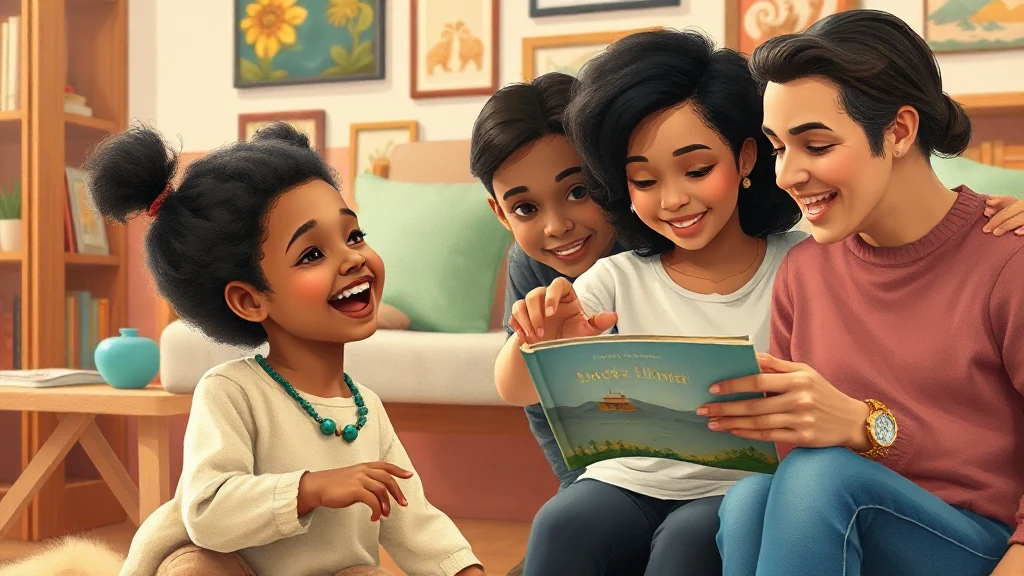
Think about the bedtime routine. The moment the rest of the house is quiet, and the world shrinks down to just the two of you and the book. The stories you read, the ones that use language as it exists for your family, become a perfect, loving mirror.
A parent once told me that when her child struggled with the academic demands of English school, the personalized story-which featured the child doing something specific that happened the previous month at home, translated into four different languages-felt like a “safety net.” It reminded them, through art and rhyme, that their life at home was rich, important, and utterly valid.
The ability to weave a child’s actual, lived experiences-the trips to the market, the family recipe, the name of the neighborhood tree-into a story is profoundly affirming. It tells them: Your life is literary.
If you’re looking for a way to make your child the heart of these rich, affirming narratives, exploring personalized books built around your family’s specific journey can be incredibly moving. Starting the process doesn’t feel intimidating; you can explore what’s possible right here: https://makemybook.app/en/console.
The Art of Translanguaging in Storytelling
In pedagogical circles, there’s a concept called “Translanguaging.” Simply put, it means acknowledging that a child’s mind doesn’t operate like a series of separate language modules (English module, Spanish module, etc.). It operates as a vast, interconnected web. The child can draw upon all linguistic resources to communicate their full meaning.
What this means for storytelling is that the most enriching books don’t separate the languages. They blend them. They allow the characters to switch mid-sentence, to use a phrase from the kitchen language and a concept from the school language, all within the same exciting plot.
A truly personalized book captures this fluid nature. It makes the child feel capable of holding all those beautiful, complex threads at once-that they are not limited to just one linguistic box. It supports their inherent identity as a masterful communicator.
I’ve found that the joy is not just in the reading, but in the act of creation with the family. Sitting down together, deciding which stories to draw from, which languages are most important to highlight, and seeing those elements woven into a cohesive, professional book-that shared creative moment is a powerful family bonding experience. It makes the process itself feel like a celebration of their whole family unit.
Making the Multilingual Narrative a Routine
If the goal is to consistently support that strong sense of identity, integrating the book into a consistent family ritual is key.
It doesn’t have to be a massive, scholarly undertaking. It can be simple.
- The Review: After a challenging school day, read a personalized scene that recounts a funny, complex family interaction, using the vocabulary of both the school day and the home language.
- The Connection: Use the book’s art-which features diverse representation-to spark conversation about other families, other festivals, and other parts of the world.
- The Ownership: Whenever possible, allow the child to dictate a few specific details or even a short phrase that must be included. That sense of ownership makes them an active storyteller, not just a reader.
This dedication to celebrating the totality of their life, linguistically and culturally, is a beautiful gift. It grounds them.
Reading a child’s life story through the lens of a personalized, multi-cultural book doesn’t just teach them words. It gifts them a narrative framework for their own self-acceptance-a framework that says: you are whole, you are connected, and your background is a magnificent story.